

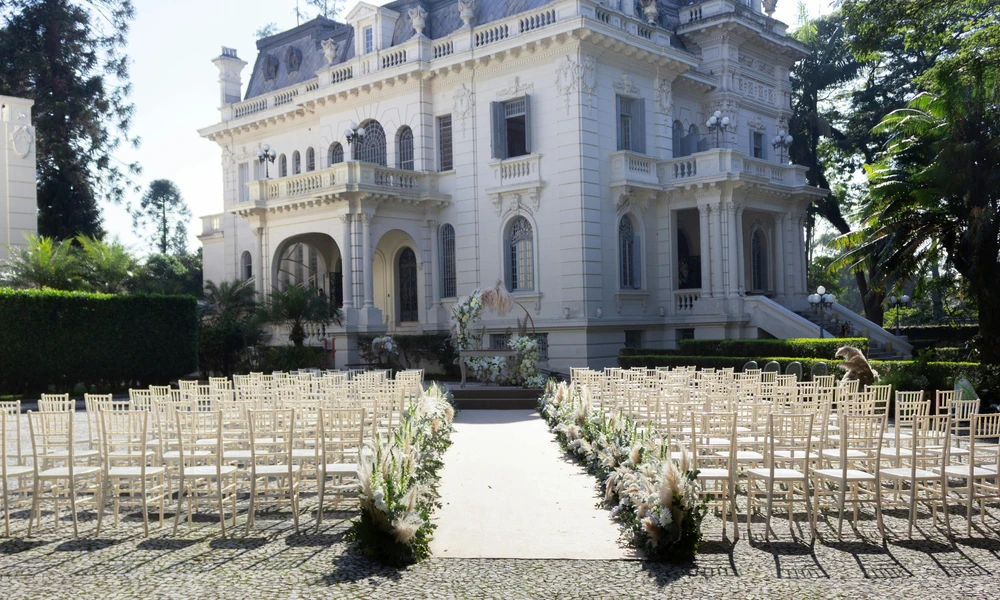
Almost every couple planning a destination wedding pictures the same scene at some point: weathered stone walls, a park full of centuries-old trees, a long banquet table set under an open sky, glasses of champagne catching the last light of the evening. It looks so cinematic that most people file it away as something meant for other people – for films, not for real life.
The truth is a lot more encouraging. France is home to a remarkable number of genuine historic châteaux, and a surprising share of them remain privately owned. Many of those estates open their doors for weddings, which means that living out your own “day in a French castle” is far less of a fantasy than it seems. It’s a concrete, bookable project: pick the estate, verify the conditions, assemble the right team, and work out the logistics.
And that last part is exactly where the glossy Pinterest boards go quiet. Behind every flawless façade there is a working reality – quite literally, a back-of-house. Before you fall in love with a photograph, someone needs to confirm whether the venue has a proper kitchen, how late the music can play, whether there are enough matching chairs for your guest count, how people will get back to their beds at 2 a.m. in the countryside, and where everyone moves if it rains. That is the honest, useful version of this dream, and it’s the one worth reading.
Why Couples Fall for a French Château Wedding
France has been one of the leading destination-wedding countries for a reason, and it isn’t only the scenery. The combination of historic architecture, world-class gastronomy, and the famous French art de vivre creates an atmosphere that’s genuinely hard to replicate elsewhere. A wedding in a French château is never just a set of pretty backdrops – it’s a full sensory experience: regional food, local wines, an aesthetic sensibility refined over generations, and the rare luxury of spending several days inside a living estate rather than passing through it for one evening.
For couples flying in from abroad, the appeal runs deeper still. A French wedding often stops being a single celebration and becomes a shared journey for the whole family – relatives and friends arriving from different countries to spend these days together. That shift, from “the big day” to “the trip we’ll all remember,” is a large part of why the château idea holds such a grip on the imagination.
An Authentic Castle Is Not a Stage Set – and Not Every “Château” Is One
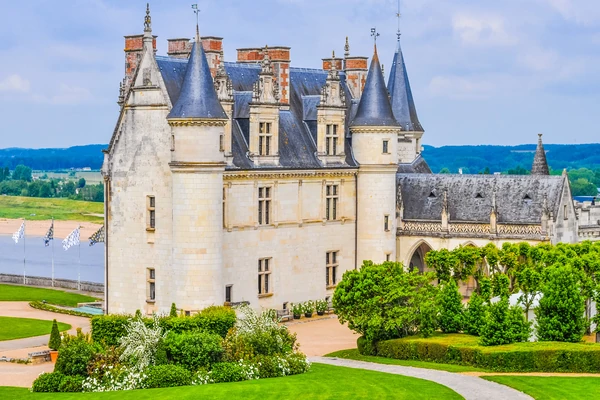
Here is where a bit of insider honesty separates a good decision from a disappointing one, because the word château is used far more loosely than outsiders assume.
In practice, venues fall into two broad camps. On one side are the authentic historic châteaux of the 16th to 18th centuries – buildings with documented pasts, many still belonging to families who live there or run the estate across generations. Booking one of these means you become a small part of its story rather than renting a backdrop. You feel the patina of time in everything: uneven stone, creaking parquet, ancestral portraits along the corridors, a park laid out centuries ago. That authenticity can’t be manufactured – it either exists or it doesn’t.
On the other side are large properties, frequently built in the 19th century or later, that today borrow the word château as a commercial name and a flattering image. These can be genuinely beautiful and are often purpose-built for events, but they deliver a very different mood. Neither option is “better” in the abstract; they simply answer different desires. So the first real question a couple should sit with is an honest one: do you want historical authenticity, with all the quirks and constraints that come attached, or a more spacious, modern space designed from the outset for celebrations? The answer shapes everything downstream, from atmosphere to budget to how complex the planning will be.
The Money Conversation: Venue Rental Versus the Whole Wedding
Cost tends to trigger the most anxiety, so it helps to separate two figures that people constantly confuse: the price of renting the venue, and the total budget of the wedding. They are not the same number, and treating them as one is how nasty surprises happen.
For the château rental alone, a realistic range runs from roughly €5,000 to €15,000. The exact figure depends on the region, the calibre of the estate, the season, the day of the week, and what’s actually included in the package. Notably, French châteaux can be comparatively good value among Europe’s prestige destination-wedding options – in more than a few cases, renting a truly historic French estate works out more favourably than a comparable venue in Italy or the United Kingdom, without the experience feeling any less special.
But the rental is only the opening line of the spreadsheet. To see the real picture, you have to zoom out to the full event. For a complete château wedding, it’s sensible to plan around a total budget starting near €30,000. That final number is built from many moving parts: guest count, the level of the estate, accommodation, catering, décor, technical production, lighting and sound, transfers, and the shape of the wedding weekend itself. Understanding what sits inside that figure removes most of the fear – it becomes clear where you can economise without losing quality, and where cutting corners will cost you at the worst possible moment.
The Practical Realities Hiding Behind the Façade
This is where the “back-of-house” thinking earns its keep, and it starts with a deceptively simple question: can you actually sleep here, and if so, who fits?
Formats vary enormously. Some châteaux offer only the venue and its reception spaces – gorgeous halls and grounds, but no bedrooms. Others provide a handful of rooms for the couple and immediate family. In some estates, guests are lodged not in the historic main house but in an outbuilding, a guest cottage, or a separate wing – which can be charming, but it’s something you want to understand in advance rather than discover on arrival. If your dream is a full wedding weekend where everyone stays together in one place, the accommodation question has to be answered while you’re still choosing the château, not after the contract is signed.
Location compounds all of this. Many historic estates sit in small villages and open countryside – a genuine part of their charm – but the nearest hotels can be several kilometres away, sometimes several dozen. Guest lodging therefore can’t be an afterthought. You need to map out early where people will stay, how many beds the surrounding area actually offers, whether those options match the tone of your wedding, and how convenient the journey to the venue will be. Sometimes it’s precisely the availability of nearby accommodation that decides between two equally beautiful sites.
And then there is the transport nobody thinks about until it’s too late. In the rural French night, you cannot rely on flagging down a spontaneous taxi – the ride-hailing apps may simply not operate there, and the local cars are long asleep. Serious château weddings plan transfers deliberately: coaches, minivans, or private cars shuttling between the hotels and the estate. The return journey after the reception matters most of all – the moment when happy, exhausted guests need to get safely to bed. Well-run transport isn’t a detail; it’s one of the things that quietly determines how the whole night is remembered.
The Insider Checklist: Sound, Heritage, Catering, Chairs
Now we’re truly in the working kitchen – the part of château weddings visible only to people who deal with these venues regularly.
Start with sound, because it breaks more dreams than anything else. Not every château lets you celebrate until dawn. If there are homes or a village nearby, the estate may cap the music volume or require amplified sound to stop after a set hour – 11 p.m. or midnight, for instance. For a couple who imagined a heaving dance floor and a DJ running late into the night, that clause can be a real blow. It has to be clarified before signing, not discovered mid-party when security approaches the DJ. The smart move is to build the whole timeline of the day around those limits, so the peak of the evening lands inside the permitted hours instead of getting cut off at its best.
Heritage protection is the next layer. Some châteaux are officially registered historic monuments – France maintains a national register through its Ministry of Culture – and that status carries concrete restrictions. Such places may forbid certain décor, open flame and candles, fixing structures to the walls, rigging lights, moving antique furniture, or using particular rooms. Often every element of styling and technical production has to be agreed in advance with the owners or managers. These aren’t whims; they’re the price of protecting a building that has survived several centuries and is meant to survive several more. But for the couple and the planner, it means creative ideas need a reality check against the venue’s rules at the earliest stage – not after a finished concept has to be dismantled to fit rules nobody flagged.
Catering hides a similar trap. Some châteaux welcome any professional caterer you like; others work only with their own partners or a closed list of approved suppliers you can’t step outside of. Just as important is the technical side: is there a professional kitchen, a proper prep zone, refrigeration, and back-of-house space? A stunning 17th-century hall can be entirely unequipped to cook and plate dinner for a hundred people, in which case the whole infrastructure has to be trucked in and built from scratch – which feeds straight back into the budget and the day’s logistics.
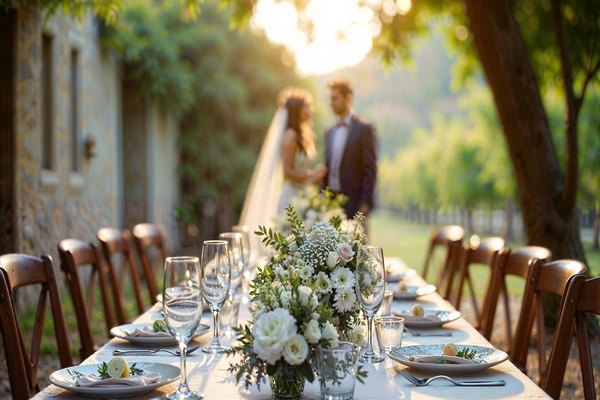
And then, almost absurdly, there are the chairs. Even a magnificent historic château may simply not own enough matching tables and seating for a wedding banquet. Furniture, linens, glassware, tableware, and part of the technical equipment often have to be hired separately. Individually these feel like trivia; together they form a substantial budget line that’s far better to know about early. “What’s included in the rental, and what do we bring ourselves?” is one of the most valuable questions you can ask at the very first meeting.
Weather, Terrain, and the Non-Negotiable Plan B
A French château is frequently chosen for exactly the reasons that make it vulnerable to the sky: the park, the garden, the terrace, the open-air ceremony. But French weather refuses to be scripted, and betting purely on sunshine is naïve.
Before you book, you need to know precisely where the ceremony, cocktails, and dinner move if it rains. Crucially, that Plan B should not be a grim fallback in a back room – it has to be a genuinely beautiful alternative you wouldn’t mind spending your wedding day inside. A good venue can always offer a worthy backup; if it can’t, that absence is itself a reason to think twice.
Terrain deserves the same forethought. A château wedding almost always involves crossing the grounds: lawns, gravel paths, and sometimes steep historic staircases. Wonderful for romantic photographs, treacherous for thin heels. It’s worth planning around – for the bride’s shoes and the guests’ alike. A gentle warning about the ground in the invitation, or a set of more comfortable shoes for the outdoor portion of the day, is the kind of small touch that saves both moods and outfits.
Why the Weekend Format Wins
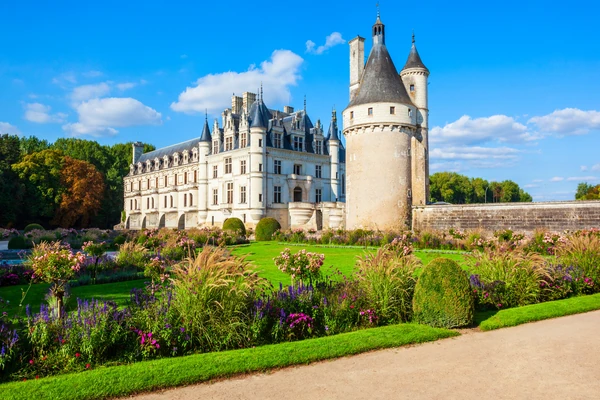
Put all of this together and one conclusion emerges: a single evening doesn’t do a French château justice. This kind of place truly opens up across a wedding weekend.
A welcome dinner on Friday, the wedding day itself on Saturday, and an unhurried brunch on Sunday let guests genuinely live inside the atmosphere of France rather than sprint through it in a few hours. For a destination wedding, that’s the pivotal shift: the celebration stops being one big night and becomes a shared journey – the sort of lifetime experience that family and friends recall for years. And it’s precisely that payoff that makes every one of the logistical challenges above worth solving.
Conclusion
For all its organisational quirks, a wedding in a French château can become one of the brightest events of your life. A genuine historic setting, French aesthetics, and the chance to gather the people you love for several days create something an ordinary banquet hall can never fully reproduce.
But behind every beautiful façade, someone still has to check the kitchen, the sound limits, the chairs, the transfers, and the Plan B. Choosing the right château demands local fluency: the venue’s restrictions, the realities of rural logistics, the quirks of French suppliers, and the strict rules governing protected historic buildings. That is exactly why, for an international or multicultural wedding, it pays to work with a wedding planning agency specialising in international weddings at French châteaux – a team on the ground that understands both the French system and what the couple actually expects. That’s when the fairytale genuinely turns real: no unpleasant surprises, and every right to simply enjoy the moment.